Years ago, during my MBA, a marketing professor once remarked that no company understood cultural marketing better than Coca-Cola. I am not sure whether he was quoting Kotler or expressing his own insight, but the certainty with which he discussed it in class stayed with me.
Coca-Cola’s Christmas campaigns in the West rarely emphasize carbonation or price. They circulate around ritual, nostalgia, and seasonal continuity. In India, Diwali advertising situates the drink within celebration rather than consumption. When the company expanded into rural markets in India, it did not attempt to redefine language. The campaign led by Aamir Khan adopted the word already in use. “Thanda” signified a cold drink in rural India, so much so that if you visit someone there, they will often ask whether you prefer tea or thanda. In the advertisement, Aamir, in a rural setting, reinforces the phrase “Thanda matlab Coca-Cola.” Coca-Cola positioned itself as the natural referent. The strategy was not linguistic correction but cultural alignment.
The setting changes, yet the instinct remains recognizable. The bottle does not try to invent rituals of its own; it finds its way into rituals that were already alive, already carrying meaning. Distribution ensures that it is within reach, and advertising ensures that its presence feels familiar rather than imposed. Over time, the brand begins to appear less like an addition and more like something that had always been there.
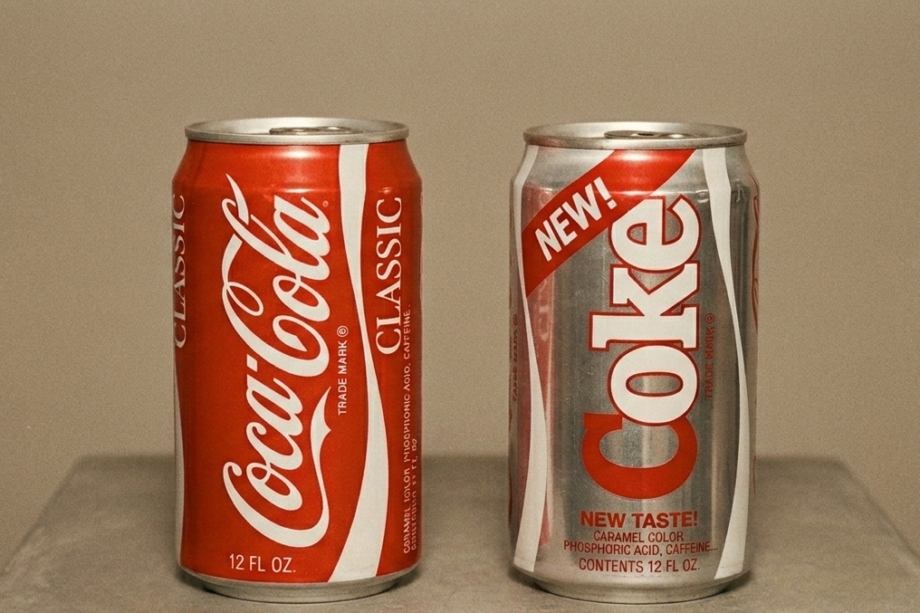
It is this history that makes 1985 difficult to read as a simple managerial misstep.
In 1984, Coca-Cola held 21.7 percent of the U.S. soft-drink market, while Pepsi stood at 18.8 percent, according to figures widely cited from Beverage Digest. The gap was narrowing, but it was not a collapse. Pepsi’s “Pepsi Challenge” campaigns turned blind taste tests into public theatre, repeatedly showing consumers choosing the sweeter drink when labels were removed. The exercise was not anecdotal; Coca-Cola’s own internal testing involved close to 200,000 participants, many of whom preferred the reformulated version in sip tests.
On paper, the signal seemed clear. If consumers consistently chose a sweeter profile in controlled comparisons, then correcting that weakness appeared disciplined rather than reactive. Large organizations are trained to respond to measurable vulnerability, especially when the measurement carries statistical confidence. The reformulation that became known as New Coke emerged from that logic.
What those tests captured, however, was preference in isolation. A sip in a white cup, detached from packaging, history, and repetition, is not the same as a bottle opened at a dinner table or purchased out of habit from the same neighborhood store. Blind testing removes context; it asks a narrow question and receives a precise answer. It does not measure what accrues quietly over decades.
For years, Coca-Cola had invested in steadiness. The campaigns that placed the bottle beside Christmas trees and Diwali lamps reinforced not novelty but continuity. The formula, unchanged for generations, became part of that continuity. Most consumers would not have described it that way, yet stability often embeds itself most deeply when it goes unnamed.
When the new formula replaced the old one in April 1985, the reaction was swift. By June, the company was receiving over 1,500 calls per day to its consumer hotline—roughly four times the usual volume—alongside thousands of letters expressing dissatisfaction. Sales volumes dipped, and by July the original formula returned as “Coca-Cola Classic.” The market share decline was not catastrophic, but it was visible enough to unsettle management and confirm that the issue extended beyond sweetness.
It is worth pausing on the trajectory that prompted the change. Even if Pepsi had continued gaining a percentage point or two annually, Coca-Cola’s distribution dominance and brand equity would not have evaporated overnight. The gap was narrowing, not collapsing. A quieter strategy—incremental adjustments to sweetness over time, or a segmented product variation rather than outright replacement—might have addressed competitive pressure without signaling rupture. The company chose the more dramatic correction, and in doing so made visible something that had previously been taken for granted.
Pepsi, for its part, did not overhaul its own formula in response to Coca-Cola’s moves. It continued to emphasize youthfulness and direct comparison, benefiting from the narrower frame it had already established. Challengers often thrive by compressing competition to a single measurable attribute. Leaders, by contrast, operate across a wider field, one shaped by habit, presence, and accumulated meaning. When a leader accepts the challenger’s frame without defending its broader territory, it risks reducing itself to the very metric it once transcended.
The backlash against New Coke is frequently attributed to nostalgia or emotional excess. That explanation captures part of the reaction but misses its structure. The reformulation did not fail solely because it was sweeter. It unsettled a product that had become synonymous with consistency. Something that had felt fixed began to appear negotiable.
When the original formula returned, it was not introduced as innovation but as restoration. The episode ultimately reinforced what had been obscured by testing: the brand’s strength did not rest on a marginal difference in taste preference. It rested on repetition, familiarity, and the quiet assurance that tomorrow’s bottle would resemble yesterday’s.
Cultural marketing often focuses on how a brand enters existing rituals. The events of 1985 suggest that cultural attachment also accumulates inward, at the level of what remains unchanged. Language, festivals, and celebrity endorsements are adaptive layers; formula, in this case, had hardened into something less flexible. The distinction is not always visible until it is crossed.
Coca-Cola’s long-term dominance survived the episode, but not because the data was wrong. The data answered the question it was designed to ask. It simply did not encompass the full weight of what the brand represented within everyday life. Quantitative clarity and qualitative attachment are not opposites, yet they do not always move in tandem.
The professor’s remark from years ago still holds. Few brands have embedded themselves across cultures with such persistence. Yet cultural fluency does not eliminate the possibility of misreading where meaning has quietly settled. Some elements invite adaptation. Others derive their power from remaining steady long enough to disappear into expectation.
The difficulty lies in telling the difference before measurement renders it visible. In mature systems, meaning settles quietly and often invisibly; it does not always announce where it resides. By the time it is disturbed, the disturbance itself becomes the only reliable signal.